
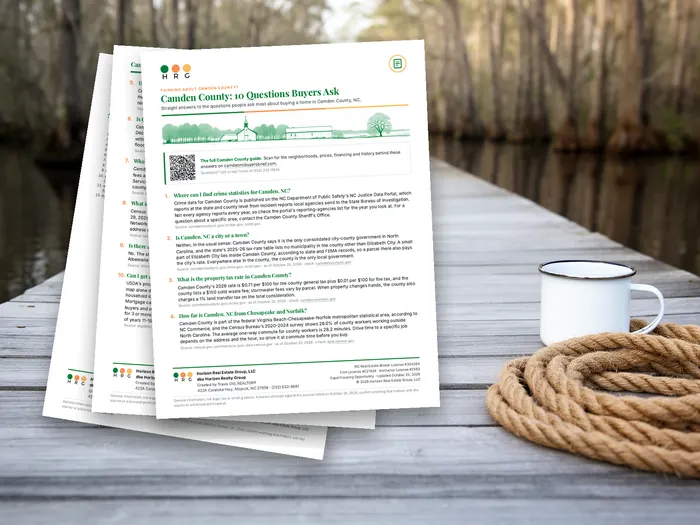
Camden Is NC's Only City-County. Six Things to Check.

In this post
- 1. One tax bill, and it is shorter than you expect
- 2. Water comes from a district, not from a town department
- 3. Fire protection is volunteer, and your insurance agent decides what that costs
- 4. EMS is new, and it is a county department
- 5. Zoning runs through one department, and the rules can be amended
- 6. Your address is a place name, not a government
- The trade you are making
The first errand tells you most of what you need to know. I walked into the building at 160C East Highway 158 looking for a town hall and found a counter where the tax office and the water office both take payments. Camden, NC 27921. No separate municipal building. No town clerk down the hall. One government, answering for everything.
Camden County is the first and only consolidated city-county in North Carolina. It reached that status in June 2006 and has run as a unified government since July 1, 2006. The county seat is the Courthouse Township of Camden, and the rest of the county is South Mills Township and Shiloh Township.
For a buyer, that structure is not trivia. It decides who bills you and who treats your water. It also decides who answers a fire call and who shows up when someone in the house needs an ambulance. Here are six checks, in the order they bite.
1. One tax bill, and it is shorter than you expect
Camden’s 2026 rate is 71 cents per $100 of value for county general tax and 1 cent per $100 for fire tax. That applies to real estate, personal property, and vehicles. The solid waste fee is $150, and stormwater fees vary by parcel.
Here is the part that surprises buyers moving down from Virginia or out from a city in the Triangle. There is no second, municipal rate stacked on top. In a county with towns you pay county tax plus town tax. In Camden you pay the one county rate plus the penny for fire. On a $350,000 assessment that is $2,520 a year before any exemptions, credits, or deferrals.
Ask for the assessed value, not the listing price. They are different numbers, and the gap is where tax surprises live. Camden’s county offices are at PO Box 190 in Camden, and the tax counter is the one on Highway 158. If a listing says “city taxes” and the parcel sits in Camden County proper, ask which city and pull the parcel record before you write the offer.
2. Water comes from a district, not from a town department
The county’s Public Works Department is built around the South Camden Water and Sewer District. That includes the water and sewer office, the R.O. Water Treatment Plant, distribution and collection, the wastewater treatment plant, and maintenance.
Water here is a district service, and a district has boundaries. If a parcel sits outside them, you are pricing a well and a septic system rather than a monthly bill. The permits for both come from the county health department, not from a town inspector, and a failed soils evaluation is one of the few problems on rural land that no amount of money fixes quickly.
So ask the question in writing: is this parcel inside the South Camden Water and Sewer District? A listing that says “public water” is not answering it. Camden County has no town water system for the words to point to.
3. Fire protection is volunteer, and your insurance agent decides what that costs
Two volunteer departments cover the county. South Mills Volunteer Fire Department sits at 127 Keeter Barn Road in South Mills. South Camden Volunteer Fire Department covers the rest. The county maintains separate Fire District Commissions for South Mills and for Shiloh/Courthouse, and the 1 cent fire tax on your bill is what funds the districts.
What the fire tax does not do is set your homeowner’s premium. The carrier sets that from the protection class of the address, and the protection class moves with distance to a responding station and distance to a reliable water source: a hydrant, a draft site, a pond with a dry hydrant.
Get the protection class in writing before your due diligence deadline. I have watched a quote change by hundreds of dollars a year between two houses a few miles apart, and the difference was the water source, not the house.
4. EMS is new, and it is a county department
Camden County EMS was established on February 15, 2025. It is county-operated, and the coverage model is specific. One ambulance staffed around the clock in Shiloh, one in South Mills, a 12-hour surge ambulance based at the Camden Courthouse, and a 24/7 paramedic supervisor also at the Courthouse.
That model exists because the county has long drive distances and one hospital corridor to reach. It also replaced a patchwork that depended on volunteers and outside resources. If you are buying in the northern end near South Mills or the southern end toward the sound, those two bases are the reason the response is not a thirty-minute run from Elizabeth City.
Ask the department, not the listing agent, how a specific address is reached. That is a phone call, and it is worth making before you commit to a rural build.
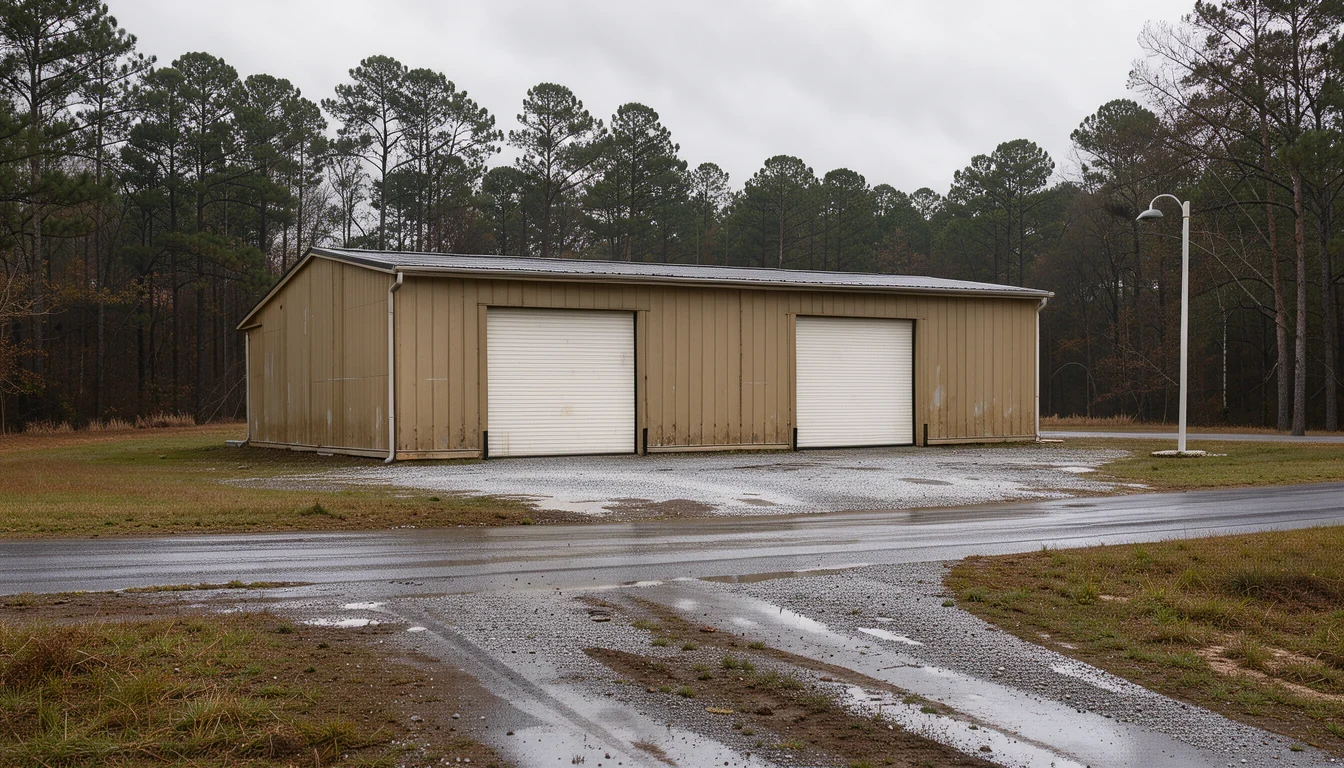
5. Zoning runs through one department, and the rules can be amended
The Planning, Zoning and Flood Department handles long-range planning for the county. With no town planning board to schedule around, the path is shorter, and the decisions concentrate in one office. A five-minute conversation there is worth an hour of reading forums.
The county works from a Unified Development Ordinance, and it currently invites written amendment suggestions through a form on its website. That matters if you are buying land with a specific use in mind, whether that is a second dwelling, a shop building, or keeping a few animals. Read the ordinance section that governs your use, then ask the department to confirm your reading before you close.
Camden is also one of 20 North Carolina counties where Coastal Resources Commission rules apply under the Coastal Area Management Act. Development inside an Area of Environmental Concern may need a CAMA permit, and that permit runs on its own clock. Waterfront buyers should read the flood and CAMA due diligence chapter before making an offer, and pull the flood quote early.
6. Your address is a place name, not a government
Camden, South Mills, Belcross, Shiloh. Those are places, not municipalities with councils and budgets. County mail goes to Camden, NC 27921. The South Mills fire department sits in 27976. A Camden County address can carry a South Mills mailing name and still be in Courthouse Township.
The one exception worth knowing: a sliver of Elizabeth City crosses the Pasquotank County line into Camden County, and parcels inside that sliver carry city taxes and city services. It is small enough that most buyers never touch it, but if a listing advertises city water and sewer in Camden County, that sliver is usually why. Check the parcel record, not the mailing address.
The trade you are making
A county with no towns is not automatically cheaper or simpler. It is narrower. You call one office and pay at one counter. What you give up is redundancy. No second set of staff. No town public works crew two miles away. No municipal police department either. And no town hall on a Tuesday night where you can ask your question in person.
The drive is the honest cost. Errands run to Elizabeth City or up into Chesapeake, and the county’s population of roughly 10,355 spread across about 241 square miles means services are distributed, not clustered. The upside is that the tax bill stays flat at 72 cents on the hundred, the farmland stays farmland, and nobody rezones the field behind your house without a county process you can read in advance.
Before you fall for a farmhouse on a lane, do the boring checks. Ask which township, and whether the parcel is inside the water district. Then get the protection class from your insurance agent in writing. Then ask the planning department how they read the ordinance for your use. Those four answers will tell you more than any staging decision in the house.
Send me the address and I’ll pull the parcel record, the township, the water district status, and the fire district for you. If the answers hold up, you’ll know what you are buying before you are standing at a counter on Highway 158 with a closing statement in your hand.
Melinda Cabot is a broker with Horizon Realty Group in northeastern North Carolina. Service facts here come from Camden County’s published pages, listed above; district boundaries, tax values, and insurance ratings are parcel-specific and should be confirmed with the county and your carrier before closing.
Keep reading

Waterfront in Camden County: Four Waters, Four Purchases
Camden County has four different waters: the Pasquotank, the North River, the Albemarle, and the Dismal Swamp Canal. What waterfront means on each.
The 1% Tax Most Camden Buyers Never See Coming
Camden is one of seven North Carolina counties levying a 1% local land transfer tax. What it costs, who pays it, and where it hides in a contract.
Camden's Tier 3 Move Cost It a Tax Credit
Camden County moved from Tier Two to Tier Three for 2026: good news about the county economy, bad news for one specific historic rehab tax credit.